How Pharmacists Are Becoming Clinical Stewards of Cell and Gene Therapy
Over the last decade, cell and gene therapies (CGT) have transitioned from experimental breakthroughs to clinical care, changing what it means to be a pharmacist.


Artificial intelligence is beginning to make its way into pharmacy workflows, but not as a replacement for pharmacists. Its most practical value is showing up in the work that surrounds patient care: documentation, prescription intake, patient communication, refill management, clinical-service support, and administrative follow-up.
For busy pharmacy teams, that matters. Retail and community pharmacies are continuing to manage higher patient expectations, persistent staffing pressure, expanding clinical services, and a growing volume of administrative work. Used well, AI may help reduce repetitive tasks and give pharmacists more capacity to apply clinical judgment. Used poorly, it can create new risks, new verification burdens, and another system for already-stretched teams to manage.
The opportunity is not to ask whether AI is “good” or “bad” for pharmacy. The better question is: where can AI consistently support pharmacists, and where does pharmacist expertise still need to lead?
"Where can AI consistently support pharmacists, and where does pharmacist expertise still need to lead?"
Pharmacists have always played a critical role in medication safety, patient counseling, and care coordination. But the demands on pharmacy teams continue to expand.
In Canada, community pharmacists are increasingly serving as accessible primary care touchpoints through services such as immunizations, medication reviews, minor ailment assessment and prescribing, chronic disease support, adherence programs, and patient follow-up.1 In the United States, pharmacists are also delivering more clinical and public-health services, including immunizations, medication therapy management, adherence support, collaborative care, and other services permitted under state scope-of-practice rules.2

Although the scope and structure differ by country and province or state jurisdiction, the operational pressure is similar. These services create more documentation, more communication, more scheduling, and more follow-up work. At the same time, many pharmacies continue to face staffing gaps and workflow interruptions that make it harder for pharmacists to spend time on the work that most requires their expertise.
This is where AI is gaining attention. Pharmacy organizations, technology companies, regulators, and professional associations are beginning to explore how AI can support pharmacy operations, clinical workflows, and workforce transformation. ASHP, for example, has framed AI as a force that may reshape the pharmacy workforce across clinical, operational, educational, research, and business domains.3
In Canada, AI adoption in community pharmacy appears to be more pilot-driven than mainstream, and meaningful examples are emerging. The BC Pharmacy Association has reported that Nova Scotia expanded AI scribe use to 46 community pharmacies, and several major Canadian pharmacy groups are testing AI pilots.4
A separate DIGITAL project involving MedMe, Asepha, the University of Waterloo School of Pharmacy, and Shoppers Drug Mart frames the opportunity around a broader workforce challenge. The project is focused on addressing Canada’s healthcare workforce shortages. It also recognizes that while recent legislation has expanded the scope of pharmacist practice, pharmacists still face high administrative burden, burnout, and a lack of pharmacy-specific tools that support efficient clinical-service delivery.5

That framing is useful beyond Canada. Across North America, the most promising AI use cases are not about replacing pharmacists. They are about reducing the administrative and workflow pressure that keeps pharmacists from spending more time on patient care.
Taken together, these examples suggest that AI is not simply a future concept for pharmacy. It is beginning to enter real workflows. But the value depends heavily on how it is implemented, what task it is used for, and whether pharmacists can safely verify and apply the information it produces.
AI is most useful when it helps pharmacy teams reduce repetitive work, find information faster, and protect time for patient care. The strongest use cases are not about replacing pharmacist judgment. They are about removing friction from the workflow so pharmacists can focus on the decisions that require their training and experience.
"The strongest use cases are not about replacing pharmacist judgment. They are about removing friction from the workflow so pharmacists can focus on the decisions that require their training and experience."
Documentation is one of the clearest near-term use cases for AI in pharmacy. Pharmacists providing medication reviews, minor ailment consultations, immunizations, chronic disease support, and other clinical services often spend significant time capturing notes, summarizing encounters, and completing follow-up documentation.
AI scribes and documentation tools can help by transcribing conversations, organizing key details, and creating draft notes for pharmacist review. This can be especially valuable when the alternative is delayed charting, after-hours documentation, or rushed notes created between patient interactions.
However, AI-generated documentation still requires pharmacist oversight. The pharmacist must confirm that the note is accurate, complete, clinically appropriate, and consistent with the patient interaction. The tool can draft, organize, and summarize, but it cannot assume professional accountability.
Privacy also matters. Ontario’s Information and Privacy Commissioner has noted that AI scribes may reduce administrative burden, but they can also introduce risks related to privacy, security, human rights, bias, accuracy, and patient trust if not governed responsibly.6
Retail pharmacy workflow is often interrupted by routine communication: prescription status calls, refill requests, appointment scheduling, reminder outreach, delivery questions, payer follow-up, and general patient inquiries.
AI-powered communication tools may help pharmacies manage some of these repetitive interactions through voice, text, chat, or automated workflows. For example, AI may help answer routine questions, route patients to the right next step, collect intake information before an appointment, or remind patients about scheduled services.
This type of AI can be valuable because it addresses one of the most persistent operational challenges in community pharmacy: constant interruption. When pharmacists and technicians spend less time managing repetitive communication, they can spend more time on clinical review, counseling, problem-solving, and patient care.
The key is to make sure AI communication tools know when to stop and escalate. A refill reminder, appointment confirmation, or general intake question may be appropriate for automation. A clinical concern, adverse effect, complex medication question, or patient safety issue should be routed to a pharmacist.
AI can also support the administrative work that surrounds prescription processing. This may include organizing faxed prescriptions, extracting key information from documents, flagging missing details, supporting refill workflows, preparing coverage approval, special authorization, exceptional access, or helping pharmacy teams track follow-up tasks.
These use cases are practical because they do not ask AI to replace clinical judgment. Instead, they ask AI to help pharmacy teams move information through the workflow more efficiently.
For example, an AI tool may help identify patient name, prescriber information, medication, strength, directions, and missing fields from a prescription document. But the pharmacist still verifies the prescription, assesses appropriateness, and determines whether additional clarification is needed.
The same principle applies to coverage approvals, special authorization or exceptional access requests, payer or plan communication, and benefit verification. The terminology differs by country, province, state, and benefit plan, but the workflow burden is similar: pharmacy teams often need to gather information, confirm eligibility, submit documentation, and track follow-up before coverage can be finalized.7
AI may also help pharmacists search, summarize, and compare clinical information more efficiently. This can be useful when pharmacists need to review drug interactions, dosing considerations, contraindications, therapeutic alternatives, guideline recommendations, or evidence summaries.
However, not all AI-generated answers are equal. For pharmacy-related questions, source quality is critical.
"Not all AI-generated answers are equal. For pharmacy-related questions, source quality is critical."
In the United States, FDA prescribing information is intended to include essential scientific information needed for the safe and effective use of a human prescription drug.8 In Canada, trusted drug information may include Health Canada product monographs and established Canadian drug and therapeutic references.9 The Canadian Pharmacists Association has also launched a CPS Content Partner Program to support integration of trusted Canadian drug and therapeutic content into health technology platforms, including clinical decision support and AI-enabled health applications.10
For pharmacists, the standard should be clear: AI may help retrieve and organize information, but clinical decisions should be grounded in reliable, current, and jurisdictionally appropriate sources.
AI may also help pharmacy teams identify patients or prescriptions that deserve closer review. For example, AI-supported tools may help surface potential interactions, duplicate therapies, adherence concerns, high-risk medications, gaps in therapy, or patients who may benefit from follow-up.
This is one of the more promising areas of AI because it aligns with pharmacist expertise. The tool does not make the final decision. It helps prioritize attention.
That distinction matters. A pharmacist’s value is not simply in knowing a drug fact. It is in understanding the patient context around that fact: age, renal function, pregnancy status, allergies, comorbidities, medication history, adherence barriers, payer requirements, drug availability, and patient preferences.
AI can help surface patterns. Pharmacists determine what those patterns mean for the patient in front of them.
For every workflow AI may improve, there are also areas where pharmacists should remain cautious. The biggest issue is not simply that AI can make mistakes. It is that pharmacists are still responsible for catching those mistakes before they affect patient care.
General AI tools are designed to generate plausible responses. That does not mean the response is complete, current, or clinically appropriate.
In pharmacy, a confident but incomplete answer can be risky. A tool may fail to account for renal or hepatic function, pregnancy, age, allergies, interacting medications, drug shortages, formulary limits, payer rules, local scope-of-practice requirements, or patient-specific clinical context.
This is why AI should be treated as a support tool, not an authority. The more closely a task touches patient care, the more important pharmacist verification becomes.

Pharmacy practice does not operate under one uniform North American rulebook. Requirements differ between the United States and Canada, and they also differ by state, province, and territory.
That matters for AI. A recommendation that sounds reasonable in one jurisdiction may not fit another jurisdiction’s scope-of-practice rules, documentation expectations, privacy requirements, formulary environment, payer processes, or prescribing authority.
For a North American pharmacy audience, this is one of the most important limitations to acknowledge. AI tools may provide general information, but pharmacy teams must apply that information within the rules and standards that govern their own practice setting.
For pharmacists, an answer is only as useful as the evidence behind it. Some AI tools provide citations, source links, or references to recognized clinical content. Others provide answers with little explanation of where the information came from.
That lack of transparency creates extra work. If a pharmacist has to retrace the AI’s work before trusting it, the tool may not save much time.
The best pharmacy AI tools should make it easy to understand the source, date, and basis for an answer. They should also make it clear when pharmacist review is required or when the available information is incomplete.
AI tools used in pharmacy may interact with sensitive patient information. That creates privacy, security, consent, and data-governance questions.
In the United States, the HIPAA Privacy Rule establishes national standards to protect individuals’ medical records and other individually identifiable health information.11 In Canada, privacy obligations vary by jurisdiction, and health organizations need to consider applicable provincial and territorial requirements. Ontario’s AI scribe guidance emphasizes privacy and security safeguards, contractual measures, monitoring, governance, and accountability to protect personal health information.
The Alberta College of Pharmacy has also cautioned pharmacy professionals to consider privacy, confidentiality, data storage, and the need to critically evaluate AI-generated information before incorporating AI into practice.12
The practical takeaway is simple: before entering patient information into an AI tool, pharmacy teams need to understand where that information goes, how it is stored, who can access it, whether it may be used to train a model, and whether the tool is appropriate for the pharmacy’s regulatory environment.
AI is only valuable if it improves the workflow. A tool that requires constant copying, pasting, checking, reformatting, correcting, or reconciling may add friction instead of reducing it.
This is especially important in retail pharmacy, where workflow speed and clarity matter. A tool may be impressive in a demo but still fail in a busy pharmacy if it does not fit naturally into existing systems, staffing models, patient flow, and documentation requirements.
The best AI tools remove work. The weakest ones simply create another queue to manage.
Before adopting or relying on an AI tool, pharmacists and pharmacy leaders should ask practical questions like these:
| Evaluation Area | Question to Ask |
|---|---|
| Purpose | What specific pharmacy problem is this tool solving? |
| Accuracy | Can the pharmacist verify the output against trusted sources? |
| Source quality | Does it rely on regulatory labeling, product monographs, peer-reviewed literature, clinical guidelines, or established drug databases? |
| Currency | Is the information kept current with labeling updates, drug shortages, guideline changes, and formulary or payer requirements? |
| Patient specificity | Can the tool account for allergies, renal function, pregnancy, age, lab values, comorbidities, and medication history? |
| Jurisdiction fit | Does it account for state, provincial, or territorial requirements? |
| Transparency | Can the pharmacist see where the information came from? |
| Workflow fit | Does it integrate into the pharmacy’s workflow, or does it create another system to manage? |
| Escalation | Does it recognize when pharmacist review is required? |
| Privacy and security | Is it appropriate for handling patient health information? |
| Accountability | Who is responsible for reviewing, approving, and acting on the output? |
| Time savings | Does it actually remove work, or does it create more work to verify? |
This type of checklist is important because AI tools are not interchangeable. The right tool depends on the task. A general AI assistant may be useful for drafting a patient-friendly explanation or summarizing a non-clinical document. A clinical decision-support tool may be more appropriate for medication-related questions. A workflow automation platform may be better suited for refill management, intake, outreach, or administrative follow-up.
The safest approach is to match the tool to the task and keep pharmacist oversight at the center.
AI may be able to summarize information quickly, but pharmacy expertise is not just about retrieving information. It is about knowing which questions still need to be asked.
Is this recommendation appropriate for this patient’s renal function? Could pregnancy, age, allergies, or comorbidities change the decision? Is there a drug shortage or formulary issue that affects what is practical? Does the patient understand how to take the medication? Is there a therapy duplication, interaction, adherence concern, or safety issue that deserves follow-up?
These are not simply data questions. They are clinical judgment questions.
"These are not simply data questions. They are clinical judgment questions."
That is why AI should be viewed as a tool that extends pharmacy expertise, not one that replaces it. It can help organize information, reduce repetitive work, and flag issues for review. But pharmacists remain essential for interpreting context, counseling patients, making professional judgments, and protecting medication safety.
The International Pharmaceutical Federation has described AI as having potential to support pharmacy practice, digital health, clinical care, and operational workflows, while also highlighting challenges such as data privacy, cybersecurity threats, algorithmic bias, and ethical concerns. Those considerations are especially important in pharmacy because the consequences of inaccurate or poorly governed information can directly affect patient care.13
AI can help pharmacies operate more efficiently, but it cannot fill an open shift, counsel a concerned patient, exercise professional judgment, or replace the trust built between patients and pharmacy professionals.
For pharmacies facing staffing shortages, AI may be part of a broader operational strategy. It can help reduce administrative burden, improve workflow, and give pharmacists more time to focus on patient care. But pharmacies still need qualified pharmacists, pharmacy technicians, and pharmacy team members who can deliver care, manage complexity, and respond when patients need human interaction as well as expertise.
That is where workforce strategy and technology need to work together.
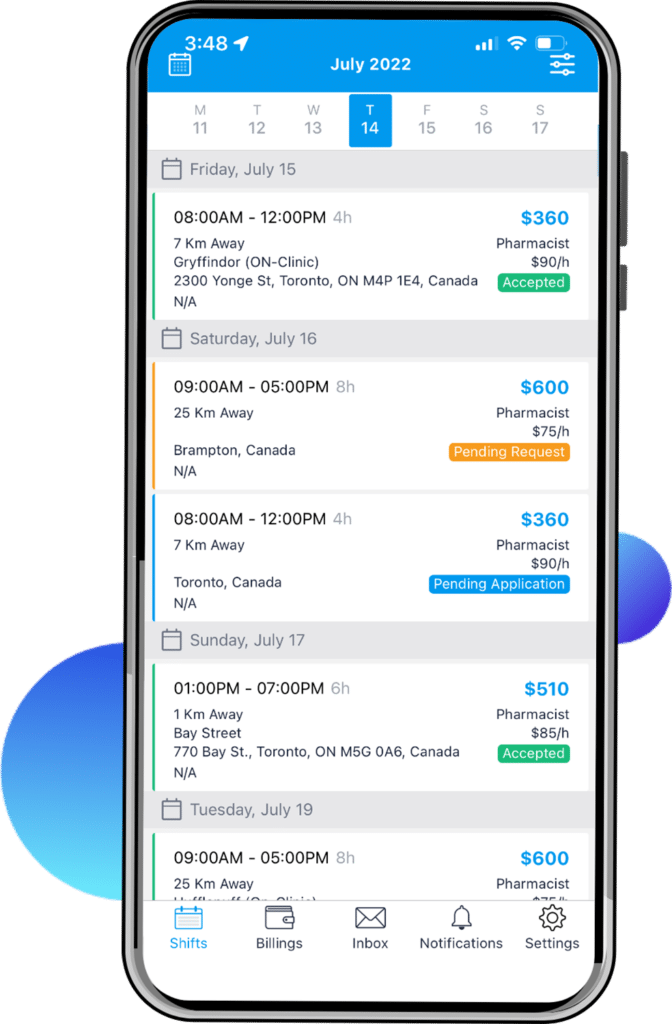
ShiftPosts helps pharmacies strengthen workforce coverage by connecting them directly with qualified pharmacy professionals when and where support is needed. Whether a pharmacy is planning ahead, covering a short-term gap, or responding to unexpected demand, ShiftPosts gives pharmacy teams a flexible way to access trusted professionals who help keep patient care moving.
Explore how ShiftPosts can help you find qualified pharmacy professionals when and where you need them most.

Sources
1 Canadian Pharmacists Association, “Pharmacists’ Scope of Practice in Canada.”
https://www.pharmacists.ca/cpha-ca/assets/File/cpha-on-the-issues/ScopeOfPractice_Oct2023.pdf
2 Centers for Disease Control and Prevention, “Collaborative Practice Agreements and Pharmacists’ Patient Care Services: A Resource for Pharmacists.”
https://stacks.cdc.gov/view/cdc/49016
3 ASHP, “Summit on Pharmacy Workforce Transformation in the Age of AI.”
https://futures.ashp.org/summit
4 BC Pharmacy Association, “AI Adoption: British Columbia pharmacists experiment with new tools.”
https://www.bcpharmacy.ca/tablet/winter-26/ai-adoption-british-columbia-pharmacists-experiment-new-tools
5 DIGITAL, “AI-Enabled Pharmacist Assistant and Patient Concierge.”
https://digitalsupercluster.ca/projects/ai-enabled-pharmacist-assistant-and-patient-concierge/
6 Information and Privacy Commissioner of Ontario, “AI Scribes: Key Considerations for the Health Sector.”
https://www.ipc.on.ca/en/resources/ai-scribes-key-considerations-health-sector
7 CDA-AMC, “Coverage Categories at Public Drug Plans in Canada.”
https://www.cda-amc.ca/coverage-categories-public-drugs-plans-canada
8 U.S. Food and Drug Administration, “Prescribing Information Resources.”
https://www.fda.gov/drugs/fdas-labeling-resources-human-prescription-drugs/prescribing-information-resources
9 Health Canada, “Drug Product Database: Access the database.”
https://www.canada.ca/en/health-canada/services/drugs-health-products/drug-products/drug-product-database.html
10 Canadian Healthcare Technology, “CPhA drug database now available for integration.”
https://www.canhealth.com/2026/02/25/cpha-drug-database-now-available-for-integration/
11 U.S. Department of Health and Human Services, “Standards for Privacy of Individually Identifiable Health Information.”
https://www.hhs.gov/hipaa/for-professionals/privacy/guidance/standards-privacy-individually-identifiable-health-information/index.html
12 Alberta College of Pharmacy, “Artificial intelligence (AI): risks and benefits.”
https://abpharmacy.ca/news/artificial-intelligence-ai-risks-and-benefits/
13 International Pharmaceutical Federation, “Statement of Policy: Artificial intelligence in pharmacy practice.”
https://www.fip.org/file/6354



Over the last decade, cell and gene therapies (CGT) have transitioned from experimental breakthroughs to clinical care, changing what it means to be a pharmacist.

As a pharmacy professional, you know the weight of a long shift, the emotional burden of being the final safety net for hundreds of patients,

Turn Great Shift Coverage into a Stronger Talent Pool As a pharmacy leader, finding shifts to fill is one challenge, but building a strong talent



When the line at the counter is growing, the phone

Every pharmacy professional dreads the moment a pharmacist is unexpectedly